
AI Coding Podcast Summaries
AI Coding on Yedapo: 71 summarized podcast and YouTube episodes. Each includes key takeaways, core concepts and notable quotes with timestamps.

Kimi K3 Just Dropped. Here's How To Actually Use It.
Leon van Zyl
Jul 21, 2026
Kimi K3 offers a cost-effective, high-performance alternative to industry leaders like Claude 3.5 Sonnet and GPT-4o for agentic coding. By leveraging the RAMP framework and MCP servers, developers can automate complex project scaffolding, testing, and deployment directly from their terminal.
Key insight: Kimi K3 is currently performing at a level comparable to top-tier models while costing significantly less, making it a highly viable option for budget-conscious developers building agentic workflows.

Fable vs GPT-5.6 Wasn’t Even Close
Matt Maher
Jul 20, 2026
While both Fable and Soul can build functional applications from design documents, their autonomy levels differ drastically. Fable excels at independent execution, whereas Soul requires intensive, iterative hand-holding to reach a production-ready state.
Key insight: Building a Parcheesi game with Soul required 65+ messages and 14 hours of active work, compared to just 6-7 messages and 3.5 hours for a similar project using Fable.

How To Use Codex To Build Insanely Beautiful Websites Using GPT 5.6 Sol
AI LABS
Jul 17, 2026
Most AI-generated websites suffer from 'AI slop'—a generic design language that screams automation. By implementing specific instruction files like design.md and using targeted skill sets, you can force AI coding agents to produce high-end, brand-specific landing pages that look custom-built.
Key insight: You can bypass generic AI design by using a 'design.md' file, which acts as a dedicated visual system instruction set, preventing the model from defaulting to its standard, overused color palettes and layouts.

AI Coding Agents tier list
David Ondrej
Jul 13, 2026
Choosing the right CLI agent determines your development velocity and model flexibility. While Claude Code and Droid emerge as top-tier tools due to their superior polish and harness quality, niche options like By-Agent offer unmatched customization. Avoid Gemini CLI, which remains functionally inferior and lacks long-term support.
Key insight: By-Agent stands out as the most lean and customizable CLI tool, allowing developers to integrate their existing model subscriptions seamlessly.
5 Plugins to Make Claude Code Autonomous
Eric Tech
Jul 5, 2026
By layering specialized plugins and automated workflows over Claude, you can transform a simple coding assistant into an autonomous engineer. This approach replaces manual prompting with a structured engineering loop that includes design reviews, automated testing, and browser-based verification.
Key insight: The 'loop engineering' workflow allows Claude to function as an autonomous engineer by recursively planning, building, testing, and reviewing backlog items without constant manual intervention.
3 Tools That Make AI Suck Less At Coding
Program With Erik
Jun 22, 2026
Rapid AI coding leads to messy, bloated repositories that are hard to maintain. By integrating static analysis tools and LLM-based evaluation frameworks, developers can automatically prune dead code and validate output quality at scale.
Key insight: You can combine deterministic static analysis (like Fallow) with LLM-as-a-judge patterns (like Kiln) to automate both code health and functional quality assurance for AI-generated features.
Claude Fable 5 in Claude Code The Hardest Coding Test Yet
Leon van Zyl
Jun 10, 2026
Anthropic's Fable 5, a new Mythos-class AI model, demonstrates a significant leap in agented coding capabilities, successfully building a complex browser-based game with ray tracing and reflections. Despite higher costs and slower planning, its impressive output quality outperforms GPT-5.5, challenging previous benchmarks on real-world complexity.
Key insight: Fable 5 successfully engineered a browser-based game engine from scratch, complete with sophisticated reflection and ray tracing systems, a task many human developers would find highly challenging.

Copilot CLI Tutorial #11 - Delegating Tasks to the Cloud
Net Ninja
Jun 9, 2026
Learn how to delegate independent coding tasks to GitHub Copilot's cloud environment, allowing you to work on multiple features or bug fixes in parallel. This workflow maximizes productivity by leveraging remote execution while maintaining control over local development.
Key insight: You can offload specific tasks to an AI agent in the cloud, have it automatically create a pull request, and then pull those finished changes back to your local environment with a single CLI command.
Copilot CLI Tutorial #9 - Custom Agents
Net Ninja
Jun 4, 2026
Learn how to build and deploy custom sub-agents to extend GitHub Copilot’s functionality. These specialized agents offload complex tasks, maintain cleaner context windows, and execute parallel workflows for more efficient autonomous coding.
Key insight: Custom agents run in their own isolated context windows, preventing the main Copilot session from hitting token limits while providing highly specialized instructions for specific tasks.

Cursor's New Coding Model Just Changed Everything
Tech With Tim
Jun 2, 2026
The new Composer 2.5 model in the Cursor IDE provides comparable, often superior, coding performance to Claude Opus and GPT-5.5 at a fraction of the cost. The integration of a specialized coding harness allows it to execute complex tasks faster and more accurately than general-purpose frontier models.
Key insight: Composer 2.5 costs approximately $0.50 per task, while the same benchmark using Claude Opus 4.7 costs $7.00—a 14x efficiency gain without sacrificing coding quality.
Atoms 2160p 2
Eric Tech
May 31, 2026
Most AI coding tools only build frontend prototypes, leaving 90% of the work—payments, databases, and SEO—unfinished. Adams replaces this with an agentic team that builds full-stack, production-ready businesses rather than just static code.
Key insight: Adams utilizes 'Race Mode' where multiple AI teams generate distinct versions of your project simultaneously, allowing you to select the best output rather than relying on a single iteration.
Claude Code Is Too Expensive. Use This Instead
Leon van Zyl
May 28, 2026
Minimax M2.7 offers a highly cost-effective, high-performance alternative to Claude Opus for coding tasks. By integrating it with Claude Code, developers can leverage a request-based billing model that dramatically reduces expenses while maintaining the ability to execute complex, multi-agent development workflows.
Key insight: Minimax M2.7 was trained using its own previous iteration to participate in its own evolution, ranking second only to Opus and GPT-4 on the MLE bench.
9 Things People Get Wrong With My /grill-* skills
Matt Pocock
May 25, 2026
AI 'grilling' isn't about letting an agent ask you endless questions; it's a strategic dialogue that requires your active leadership. Success depends on managing scope, knowing when to pivot to prototyping for high-fidelity tasks, and preserving your valuable context instead of discarding it.
Key insight: You don't need a high-end frontier model for implementation, but you DO need one for grilling because the process relies heavily on the model's 'parametric knowledge' to challenge your design assumptions.
/handoff is my new favourite skill
Matt Pocock
May 21, 2026
Avoid the 'dumb zone' of massive token context windows by using a handoff skill. Instead of diluting your session with tangential tasks, compress your state into a markdown file and cleanly transition context to new, specialized agent sessions.
Key insight: Agents lose effectiveness as context windows fill up, entering a 'dumb zone' where attention becomes diffuse; manual session handoffs are a simple, high-leverage way to preserve intelligence.
Copilot CLI Tutorial #3 - Code Changes
Net Ninja
May 19, 2026
Learn how to use Copilot CLI to perform code edits, navigate interaction modes, and manage permissions effectively. The demonstration covers moving from manual confirmation to autonomous 'Autopilot' mode for complex multi-file tasks and executing shell commands directly.
Key insight: Autopilot mode allows Copilot to iterate on complex tasks, including self-correcting build errors and testing, by holding shift and pressing tab twice.
Devin AI Is the Future of Coding… Full Tutorial
Tech With Tim
May 18, 2026
Cognition has evolved Devin from a standalone tool into a comprehensive ecosystem. By integrating local terminal agents, cloud-based virtual machines, and platform-wide integrations like Linear and GitHub, Devin now functions as an autonomous junior engineer capable of managing complete software development lifecycles independently.
Key insight: You can transform any GitHub pull request into a Devin review by simply replacing 'github.com' with 'devinreview.com' in the URL, triggering an automated AI analysis of the code changes.
My Vue + Nuxt AI Coding Setup in 2026
Program With Erik
May 18, 2026
Boost your productivity by integrating specialized AI skills and configuration files into your development environment. By moving beyond basic chat models and implementing structured best-practice 'skills,' you can automate adherence to framework standards and generate cleaner code automatically.
Key insight: Using an 'agents.md' file allows you to bake project-specific architectural rules directly into your AI context, ensuring consistent adoption of patterns like the Composition API without needing manual activation.
Copilot CLI Tutorial #2 - Commands
Net Ninja
May 18, 2026
Effective use of the GitHub Copilot CLI relies on mastering built-in slash commands for environment management and strategic model selection. By optimizing model reasoning levels and command flags, developers can significantly enhance coding workflows while managing token usage efficiently.
Key insight: Slash commands often support optional flags, such as the 'summarize' flag in the changelog command, which dynamically alters the AI's output format.

Claude Code for Beginners Tutorial
freeCodeCamp.org
May 13, 2026
Jeremy Morgan demonstrates how to use Claude Code to scaffold, architect, and maintain robust Python and JavaScript applications. The episode highlights the tool's ability to act as an autonomous developer, generating production-ready code, unit tests, and comprehensive documentation while managing multi-file complexity.
Key insight: Claude Code can autonomously analyze entire multi-language codebases to identify architectural debt, security vulnerabilities, and logic bugs, often suggesting and implementing structural fixes like service-layer abstractions.
AI Coding for Beginners (Full Course 2026)
Riley Brown
May 7, 2026
Riley Brown demonstrates 'vibe coding'—a workflow using AI agents to build, deploy, and manage web, desktop, and mobile applications from natural language prompts. By integrating GPT-5.5 with Firebase for backend services, users can create complex, multi-user software without writing a single line of traditional code.
Key insight: You can transform a single web app into an Electron desktop app and a native iOS app using only natural language prompts and an AI agent, while maintaining a shared backend database and authentication across all platforms.
I Built a YouTube Summarizer with a RANDOM AI Tool
Leon van Zyl
May 4, 2026
This session demonstrates the rapid development of an AI-powered YouTube summarization application using Cursor's Composer 2. By leveraging agentic coding workflows, Next.js, and the AI SDK, the host automates UI generation, transcript retrieval, and structured data extraction.
Key insight: Cursor’s Composer 2 agent can autonomously manage browser-based end-to-end testing, allowing it to verify its own UI generation and API integrations without human intervention.

The Ultimate Non-Technical Guide to Claude Code
Futurepedia
Apr 30, 2026
Claude Code acts as an agentic developer that plans, codes, tests, and deploys applications directly from your local machine. By using natural language, you can build everything from games to AI-powered web apps without writing manual code.
Key insight: You can deploy full-stack web applications to the live internet using only natural language prompts and free tiers of GitHub and Vercel.
How To De-Slop A Codebase Ruined By AI (with one skill)
Matt Pocock
Apr 29, 2026
AI-generated code often accelerates software entropy, resulting in brittle 'balls of mud'. By applying architectural principles like deep modules, seams, and adapters, developers can transition from passive code generation to strategic architectural oversight, ensuring long-term maintainability.
Key insight: The most effective way to manage AI code generation is to act as a 'strategic programmer' (the general) directing AI 'tactical programmers' (the sergeant) by enforcing module depth and clear interface boundaries.
Your AI Agent Is Only as Good as Your This One File
AI LABS
Apr 28, 2026
Optimizing your agent's performance requires moving beyond default settings. By structuring your claude.md file with explicit 'think before coding' instructions, goal-driven verification, and path-scoped rules, you can eliminate constant course correction and prevent the agent from hallucinating complex solutions when simple ones suffice.
Key insight: Keep your claude.md file under 300 lines to maintain peak agent performance; exceeding this length leads to context bloat and degraded decision-making.

Top 5 Claude Code Skills... 100,000+ github stars
Jack Roberts
Apr 25, 2026
Jack Roberts details five advanced techniques for Claude Code to optimize business operations and lower token usage. By leveraging specialized knowledge graphs, web-scraping agents, and intelligent model routing, developers can build faster while drastically reducing overhead costs.
Key insight: Claude Code token costs can be slashed by over 70% by using 'Graphify' to map your codebase into a queryable knowledge graph, allowing the AI to jump straight to relevant files instead of parsing the entire project.
Claude Code Routines - It Codes While You Sleep
Leon van Zyl
Apr 21, 2026
Claude Code Routines allow developers to schedule autonomous agents that scan codebases, detect security vulnerabilities, and implement structural improvements. By leveraging custom skills and recurring triggers, these agents handle maintenance tasks like OWASP compliance and refactoring, enabling a 'set and forget' workflow for codebase health.
Key insight: An automated security routine can instantly reveal that even a simple 'to-do' application has dozens of critical vulnerabilities, such as hard-coded API keys and lack of CORS policies, that might go unnoticed by human developers.
Gemma 4 Makes Claude Code 100% FREE
Leon van Zyl
Apr 16, 2026
Running powerful coding agents locally is no longer restricted to cloud APIs. By pointing Anthropic's Claude Code CLI to a local Gemma 4 26B model via LM Studio, developers can build and debug full-stack applications with zero API costs and total privacy.
Key insight: Gemma 4's 26-billion-parameter model uses a Mixture of Experts architecture, loading only 4 billion parameters for a given task, making it blazingly fast on consumer-grade GPUs.
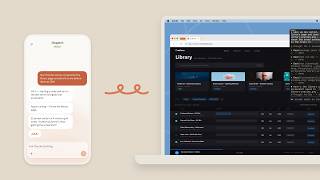
How Claude Code Works
Claude
Claude Code transforms your terminal into an autonomous coding agent by utilizing a continuous loop of execution, verification, and context management. Unlike static chat windows, it actively interacts with your codebase through tools to complete tasks autonomously while maintaining security via configurable permission modes.
Key insight: Claude Code autonomously manages its own context window through an auto-compaction process, summarizing past interactions to stay within limits during complex, long-running coding tasks.

Prompting is dead. Here is how you create loops
Alex Finn
Stop manually prompting AI agents for every task. By implementing a 'spec-build-review' loop, you can transition from active coding to managing an autonomous system that handles development, testing, and deployment while you are away.
Key insight: You can use a simple slash command like '/loop 5 min /him build' to force an AI agent to autonomously iterate on tasks every five minutes without human intervention.

Claude Code Tutorial: Beginner to Advanced in 20 Minutes
Zinho Automates
Claude Code isn't just a chatbot; it's an AI-driven development environment that plans, codes, and deploys applications. By mastering 'Plan Mode', configuration files, and MCP connectors, you can move from a simple prompt to a fully deployed business tool without writing manual code.
Key insight: Using a 'claude.md' file acts as a permanent project manual, ensuring the AI maintains your specific coding standards, design rules, and logic preferences across every session.


