
mathematics Podcast Summaries
mathematics on Yedapo: 12 summarized podcast and YouTube episodes. Each includes key takeaways, core concepts and notable quotes with timestamps.

But what is cross-entropy? | Compression is Intelligence Part 2
3Blue1Brown
Jul 16, 2026
This analysis reveals that cross-entropy, a cornerstone of AI training, is fundamentally linked to data compression. By reframing model training from 'next-token prediction' to 'compression,' we gain a deeper intuition into why language models learn the structure of reality.
Key insight: The fact that a generic file compression algorithm like gzip can successfully cluster languages and reconstruct their lineage without any pre-baked linguistic knowledge proves that compression is a deep proxy for understanding structural patterns.
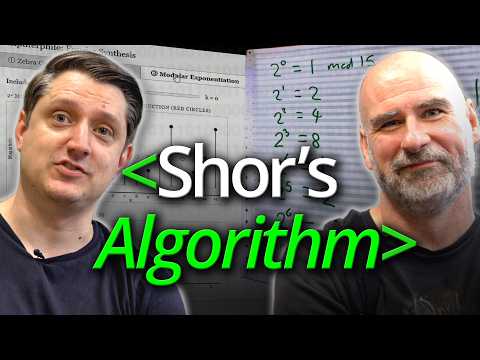
Shor's Algorithm for Quantum Computing - Computerphile
Computerphile
Jul 9, 2026
Shor's algorithm leverages the interference of quantum waves to perform efficient integer factorization, a process that threatens modern RSA encryption. By reframing factorization as a period-finding problem, the algorithm exploits wave physics to solve classically intractable equations, offering a reality-based explanation of quantum computing without relying on the 'many-worlds' interpretation.
Key insight: Everything in quantum computing can be reduced to the constructive and destructive interference of waves—it's essentially the same physics that makes JPEGs work, just applied at a quantum state level.

Grant Sanderson (@3blue1brown) – AI disproved a famous math conjecture. Now what?
Dwarkesh Patel
Jun 30, 2026
Artificial Intelligence is progressing fastest in mathematics, acting as a lead indicator for broader economic disruption. The core challenge is shifting from mere theorem-proving to the far more complex task of generating novel definitions and unified conceptual architectures.
Key insight: The 'dirty secret' of the International Math Olympiad is that while geometry problems can be solved via brute-force algorithms in seconds, combinatorics problems still require a level of creative 'play' that remains elusive for current AI architectures.
100 random chords, how many intersections?
3Blue1Brown
Jun 16, 2026
Calculating intersection points for random chords requires precise definitions to avoid Bertrand's paradox. By selecting two points uniformly along the circle's circumference, you create a consistent model where the expected number of intersections follows a predictable mathematical pattern. This approach transforms a seemingly ambiguous geometric problem into a solvable exercise in probability.
Key insight: Bertrand's paradox proves that 'choosing a random chord' is mathematically ill-defined without specifying the exact method of selection, as different distributions yield different probabilities.

DeepMind’s New AI Found A Strange New Way To Think
Two Minute Papers
Jun 5, 2026
Dr. Károly Zsolnai Fehér explains how DeepMind’s AlphaProof Nexus solves complex, long-unsolved mathematical problems by wrapping unreliable AI models in a competitive 'tournament' loop. By using a formal verification language and a judge that ranks iterative attempts, the system generates reliable proofs from unreliable parts, proving that system architecture is now as critical as model intelligence.
Key insight: AlphaProof Nexus solved nine decades-old mathematical problems that humans couldn't crack for 56 years, at a cost of only a few hundred dollars per problem.
Tie random ends: How many loops?
3Blue1Brown
May 21, 2026
Connecting random string ends eventually forms a collection of closed loops. By calculating the expected number of loops when starting with 50 strings, you uncover the underlying probability patterns governing random connections. This puzzle demonstrates how complex systems simplify into predictable mathematical outcomes through iterative random processes.
Key insight: When you tie random ends of 50 strings together, the average number of resulting loops is determined by the harmonic series, specifically the sum of 1/i from 1 to 50.
Escher's most mind-bending piece
3Blue1Brown
Mar 27, 2026
M.C. Escher’s 'Print Gallery' creates a recursive loop that defies traditional perspective. Mathematicians Bart de Smit and Hendrik Lenstra revealed that the image’s central blank spot is not merely an omission, but a mathematical necessity resulting from a complex transformation known as the logarithm of an image, which resolves the work's inherent spatial paradox.
Key insight: The central white hole in Escher's 'Print Gallery' is a mathematical byproduct of the image's recursive structure, effectively compressing all the ambiguity of the scene's perspective into a single, empty space.
The most beautiful formula not enough people understand
3Blue1Brown
Feb 27, 2026
Grant Sanderson argues that higher-dimensional geometry is a counterintuitive but essential tool for modern computation. By visualizing the recursive relationship between spheres and their boundaries, he reveals that in high dimensions, these shapes paradoxically become almost entirely concentrated at their surface and essentially vanish in volume relative to the space they inhabit.
Key insight: In 100 dimensions, a unit ball is so vanishingly small—approximately 2.37 x 10^-40—that it is essentially nothing, demonstrating why our three-dimensional intuitions fail in high-dimensional data spaces like machine learning.

Infinity, Paradoxes, Gödel Incompleteness & the Mathematical Multiverse | Lex Fridman Podcast #488
Lex Fridman
Dec 31, 2025
Joel David Hamkins explains how Georg Cantor’s discovery of multiple, distinct sizes of infinity shattered the foundations of 19th-century mathematics. By moving beyond the 'potential' infinity of the Greeks to an 'actual' infinity, mathematicians were forced to rebuild their field using set theory and axiomatic systems like ZFC to resolve paradoxes.
Key insight: Every natural number is interesting; if there were any 'boring' numbers, the smallest one would be 'interesting' precisely because it was the first boring one, creating a logical contradiction.

o3-mini and the “AI War”
AI Explained
Jan 31, 2025
OpenAI's O3 Mini pushes cost-effective reasoning frontiers, yet exhibits strange, unpredictable personality shifts that contrast with its high-end coding prowess. While it excels at mathematics and coding, its failure on simple social reasoning benchmarks highlights the growing, erratic divide between raw capability and real-world intelligence.
Key insight: O3 Mini failed a basic empathy-driven social reasoning test, suggesting it currently prefers 'crypto hustling' over human-like social understanding, despite being a prodigy in complex mathematics.
How I animate 3Blue1Brown | A Manim demo with Ben Sparks
3Blue1Brown
Oct 12, 2024
The creator of 3Blue1Brown pulls back the curtain on Manim, the custom Python engine used to animate his mathematical content. This technical deep dive reveals how programmatic animation allows for complex, iterative visual storytelling that would be impossible with traditional frame-by-frame tools.
Key insight: The most effective way to animate complex mathematics is to treat scenes as programmatic objects where every element—from LaTeX equations to 3D chaos attractors—is defined as a code-manipulable mobject.
25 Math explainers you may enjoy | SoME3 results
3Blue1Brown
Oct 7, 2023
Great math communication isn't about being good for everyone; it’s about being perfect for a specific audience. The Summer of Math Exposition highlights that the most effective explanations often frame technical concepts through clear, niche-specific mental models rather than general appeal.
Key insight: The 'backburner problem'—maintaining a persistent, curious mathematical question in your mind—is one of the most effective ways to stay engaged with learning, regardless of its immediate real-world utility.