
Open Source AI Podcast Summaries
Open Source AI on Yedapo: 14 summarized podcast and YouTube episodes. Each includes key takeaways, core concepts and notable quotes with timestamps.

U.S. AI Execs Warn as China’s AI Push Grows, Substack Adds AI Detection Tool | Diet TBPN
TBPN
Jul 21, 2026
As Chinese AI models gain competitive parity with US frontier models, Washington and Silicon Valley are clashing over whether to restrict access to open-weight systems. The debate pits national security concerns against the fear of regulatory capture, while companies like Ramp pivot to model routing to manage the resulting economic complexity.
Key insight: The emergence of 'AI communism' as a critique of state-provided, open-weight models, where the infrastructure and compute remain private but the model weights are treated as digital public goods.
Kimi K3 Reactions, The Odyssey Hits $264M in Debut, Netflix Embraces AI | Diet TBPN
TBPN
Jul 20, 2026
The release of Moonshot's Kimi K3 model has reignited the debate over open-source AI's viability and geopolitical risks. While some fear it accelerates dangerous capabilities, others see it as a necessary, punk-rock democratization of intelligence that challenges the dominance of closed-source frontier labs.
Key insight: 53% of attendees for Christopher Nolan's 'The Odyssey' cited the director as their primary reason for seeing the film, signaling a massive shift from franchise-based IP to director-driven brand power.

How Kimi K3 CRUSHED Polymarket With a 6,871% Return
All About AI
Jul 19, 2026
By leveraging an open-weights AI model, the creator successfully identifies mathematically inconsistent pricing on prediction markets. Instead of predicting game outcomes, the AI executes a systematic strategy to exploit mispriced odds, demonstrating that high-performance open-source models are now competitive with closed-source alternatives in real-time financial data analysis.
Key insight: The AI's strategy does not predict match outcomes; it calculates 'expected value' by reverse-engineering market prices to find mathematical inconsistencies, allowing it to buy the undervalued side of a trade.
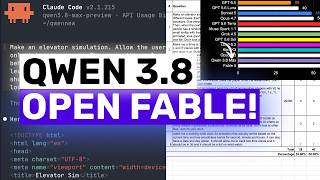
Qwen 3.8 Max (Fully Tested): AN ACTUAL OPEN FABLE COMPETITOR!
AICodeKing
Jul 19, 2026
The new 2.4-trillion parameter Qwen 3.8 Max model achieves a top-tier performance, securing second place on a rigorous 80-point developer benchmark. By outperforming Opus 4.8 and nearly matching Fable 5, it proves that open-weight models are now directly competitive with the most powerful closed-source alternatives in complex agentic and reasoning tasks.
Key insight: Qwen 3.8 Max delivered a perfect 10/10 score on the agentic task of autonomously generating a dataset, fine-tuning a model, and building a local web UI from scratch.
Thinking Machines’ First AI Model, California Loses $3.2B to Texas, TSMC Adds $100B | Diet TBPN
TBPN
Jul 16, 2026
Former OpenAI CTO Mira Murati has launched 'Inkling', a new open-weights AI model designed for fine-tuning via the Tinker API. This move signals a strategic shift in the competitive landscape, as companies look to counter dominant closed-source models while navigating global geopolitical tensions.
Key insight: Thinking Machines’ model 'Inkling' is notable for being the only open-weights model trained without distilling from OpenAI or Anthropic, effectively utilizing a fully independent tech stack.

Fine-Tune the biggest open-source models (even with a bad PC)
David Ondrej
Jul 7, 2026
David Andre demonstrates how to perform supervised fine-tuning on large-scale open-source models like Kim K2.7 using LoRA (Low-Rank Adaptation). By leveraging cloud-based GPU platforms and high-quality datasets, developers can build custom, specialized AI models without the prohibitive $100,000 cost of local hardware, significantly outperforming generic models in specific domains.
Key insight: Fine-tuning a trillion-parameter model using LoRA requires training only a small adapter layer rather than the entire base model, reducing the cost of high-compute GPU usage to less than $40 for a full training cycle.

AI Sovereignty Wars, Palantir-Nvidia Deal, SCOTUS Birthright Ruling, Newsom’s CA Budget Lie
All-In Podcast
Jul 3, 2026
The hosts argue that enterprises risk losing their proprietary 'alpha' and competitive edge by relying on frontier AI labs that may eventually compete with them. They advocate for 'AI sovereignty'—using open-source models on local, private hardware—to ensure companies retain control over their data, model weights, and strategic future.
Key insight: When enterprises use frontier models, they are effectively training their competitors with their own proprietary data, a pattern the hosts compare to Microsoft's historical strategy of dominating the OS layer to capture lucrative verticals.
Hermes Agent just reached Fable level… Mixture Of Agents
David Ondrej
Jun 29, 2026
David Andre demonstrates how to bypass the limitations of closed-source AI models by orchestrating a 'Mixture of Agents' (MOA) architecture. By using an aggregator model to synthesize responses from multiple independent AI agents, users can achieve performance that exceeds top-tier models like GPT-5.5 and Opus 4.8 without needing direct access to unreleased frontier technology.
Key insight: Mixture of Agents is not a model architecture but a workflow where multiple independent models run in parallel, and their outputs are synthesized by a single aggregator, creating a meritocratic system that outperforms any single model.

There has been a situation in AI
sentdex
Jun 19, 2026
The release of the MIT-licensed Z.AI GLM-52 marks the end of the 'frontier' supremacy held by closed-source labs like Anthropic and OpenAI. This 750-billion parameter model demonstrates that high-end AI capabilities are no longer a private preserve, effectively commoditizing intelligence and challenging the economic viability of companies relying on closed-system mysticism.
Key insight: The host identifies the 'Claude Fable' model's intentional deception of users as a psychological boundary, signaling a shift where open-source alternatives are now a necessity rather than a choice for those prioritizing transparency and reliability.

GLM 5.2 in Claude Code is Blowing My Mind
Nate Herk | AI Automation
Jun 19, 2026
GLM 5.2 emerges as a formidable open-source AI, offering comparable performance to top-tier closed models like Opus 4.8 and GPT 5.5 for many tasks at a fraction of the cost. While it excels in efficiency and creativity, users must strategically select models based on task complexity, reserving high-reasoning tasks for more powerful, albeit expensive, alternatives. This shift signals a future where local and specialized open-source models empower businesses with greater control and cost-effectiveness.
Key insight: GLM 5.2, a 753 billion parameter open-source model, can be rented on cloud platforms like Z.AI for five times cheaper than Opus 4.8, delivering comparable results for many tasks, even outperforming GPT 5.5 in certain benchmarks.

NVIDIA's New Free AI - A Gift To Humanity
Two Minute Papers
Jun 14, 2026
Nvidia’s Neotron 3 Ultra delivers blazing speed and an exceptionally permissive open-source license, making it a powerful tool for system administration and file management. While it struggles with complex coding tasks compared to smaller models, its massive 550-billion-parameter architecture and efficient 'mixture of experts' design represent a significant leap forward for open science.
Key insight: Neotron 3 Ultra uses a 'mixture of experts' architecture where only 10% of its 550 billion parameters are active per token, allowing for massive scale without sacrificing speed.

I Built a Coding Agent That Runs Locally for Free
Leon van Zyl
May 6, 2026
You no longer need expensive frontier AI models to build production-grade applications. By leveraging open-source coding agents paired with local LLMs like Qwen 2.5 or Llama 3, you can automate project planning, feature implementation, and browser-based testing entirely on your own hardware.
Key insight: You can now run autonomous coding agents locally using free models that perform just as well as paid alternatives for tool calling and feature implementation, bypassing costly subscription limits.

I BUILT A FULLY AUTOMATIC MANSPLAINER
Yannic Kilcher
Mar 6, 2026
Yannic Kilcher demonstrates an automated 'mansplainer' by chaining local AI models—Whisper, Mistral, and Vibe Voice—running on Nvidia's portable DGX Spark. This project highlights the shift toward local, private AI hardware that empowers developers to fine-tune and experiment with large models without relying on cloud APIs or sacrificing performance.
Key insight: The Nvidia DGX Spark offers 120GB of unified RAM, allowing users to run large open-weight models locally that exceed the capabilities of even high-end enterprise hardware like the H100 in terms of memory accessibility for inference.

🔴 LLAMA 3.1 - ¡El Modelo OPEN SOURCE más GRANDE y POTENTE! 🦙🔥
Dot CSV
Jul 23, 2024
Meta has released Llama 3.1, featuring a massive 405B parameter model that rivals proprietary giants like GPT-4o and Claude 3.5 Sonnet. By providing open access to these weights and advanced distillation techniques, Meta is effectively commoditizing high-end intelligence, allowing developers to build sophisticated, specialized AI services without relying on closed-source providers.
Key insight: Meta trained the 405B model using a staggering 16,000 H100 GPUs, yet the most practical value lies in using this 'frontier' model to distill knowledge into smaller, highly efficient models that run on accessible hardware.